In 1972 there appeared an article on Joseph L. Brady's computations for Planet X based on the perturbations of some comets, most notably Halley's comet,
which always arrived four days earlier or later than predicted. He used Berkeley's high speed computers over a 4-year period to establish a ten-planet model
of our solar system from Mercury to Planet X.
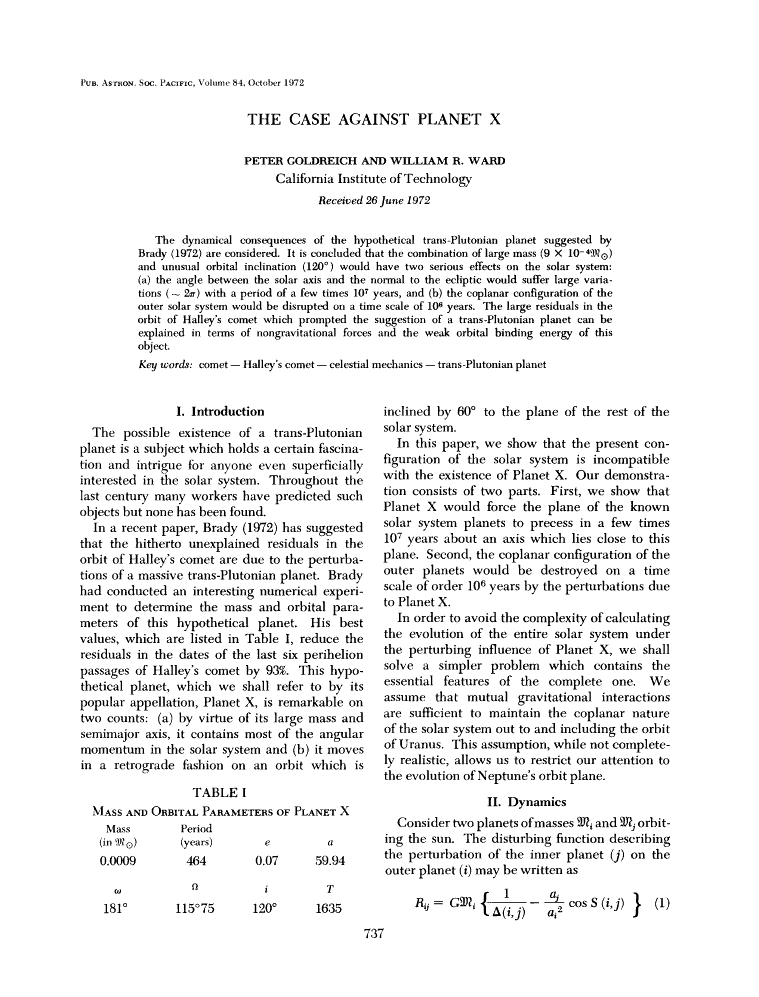 In the paper are listed the orbital parameters of Planet X which gives an AU of 59.94, an orbital period of 464 years, and a high inclination to the ecliptic of 120 degrees. What's really fascinationg about Brady's claims is that it orbits in retrograde fashion against the other planets and that it is some 300X the mass of Earth, or larger than Saturn but smaller than Jupiter. Joseph Lajus Brady was born on May 14th, 1917 in Keokuk, Iowa and later moved to Berkeley, California where he became a mathematical astronomer, focusing on periodical comets such as Halley, Olbero, and Pons-Brooks. He successfully predicted the return of Halley's comet for 1986 and then, over a 4-year period, with partner Edna Vienop, developed a ten-planet computerized model of our solar system based on the perturbations of Halley's comet going back 1700 years. The results were eye-opening. Brady successfully linked the perturbations of three comets Halley, Olbers, and Pons-Brooks. to a presumably massive undiscovered 10th body beyond Pluto. Astronomers quickly dismissed his findings saying that such a large body would have been easily spotted. He said it would be located in the constellation of Cassiopea. Later on, Brady revised the mass of his Planet X from about 300 times that of Earth to half that of Earth, still making it a sizeable planetary body. In 2005, another astronomer, Tuttle, confirmed Brady's findings but gave the object an AU of 59.70, an orbital period of 461 years and an inclination of 115 degrees to the ecliptic. It would then be located in the constelllation Cygnus. I did more digging and found more information. In his 1972 paper "The Effect of a Trans-Plutonian Planet on Halley's Comet" Brady explains how he arrived at his conclusions and on page 9 of the paper also gives a map of the location of his Planet X in Right Ascension and Declination for the years 1929 and 1946. The darkened or stipled area is where Tombaugh concentrated, but Brady's Planet X would lie further north of those areas. You can read the full 9 page (PDF) article here
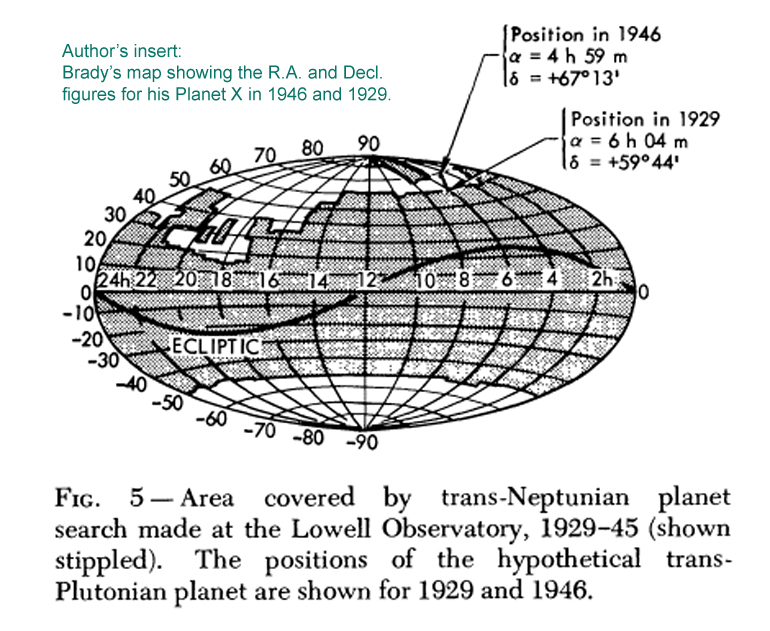 For astrologers, the tropical equivalents are: 1929: RA 6h04m Decl 59d 44m = 0Can37. For 1946: RA 4h 59m Decl 67d 13m = 14Gem38. So from 1929 to 1946 Brady's planet X moved BACKWARDS from tropical 0Cancer37 to 14Gem38. That's 16 degrees retrograde in 17 years. Important note/correction: the 1946 longitude equivalent should read 14Gem38 instead of 21Gem49. My apologies. Brady died sorrowful on Feb.17, 2013 without seeing the telescopic discovery of his planet X. Was his info being repressed, or was he simply wrong? Only the future will tell. |