Note: The following article is largely speculation and may or may not be accurate. There is a red dwarf in late tropical Sagittarius called OGLE-2005-BLG-390L around which the planet OGLE-2005-BLG-390Lb orbits. This Neptune-sized planet discovered by PLANET from the La Silla observatory in Chile in 25 Jan 2006 may well be the long-sought for Nibiru making its parent star the Dark Star or Nemesis. This may also be the object photographed by Iras in 1983.
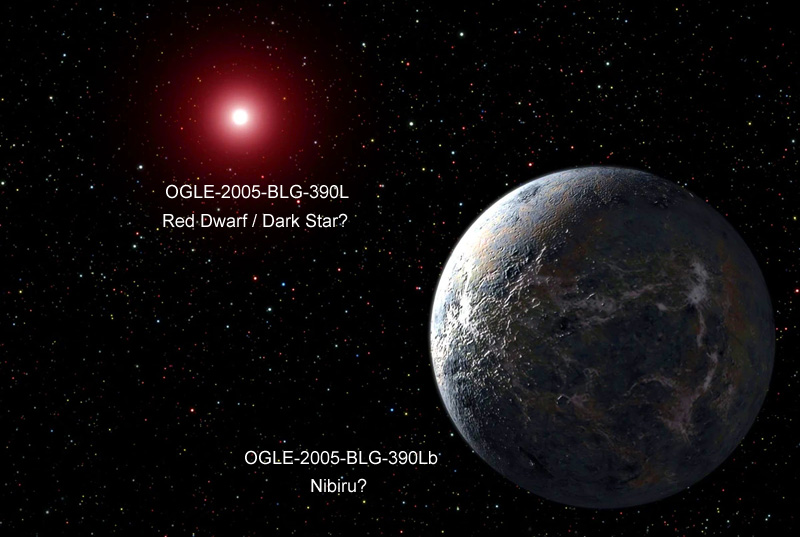 Only this "star" and its companion are not light years away as astronomers tell us, but within our own solar system. and may actually have an orbital period of only 792 years, according to Jason Breshears of ARCHAIX. I feel the concept of distance in light years will prove to be one of the greatest frauds in modern astronomy. Stellar objects and perrhaps even planetary ones are far closer to us than we are told, probably as close as the dome above us. Their orbital time periods, however, are usually as described. Here is a tropical ephemeris of OGLE-2005-BLG-390L for 1850 to 2050 according to astronomical sources.
1900 = 28Sag08 and -30deg 22min 10sec decl 1950 = 28Sag27 and -30deg 22min 38sec decl 2000 = 28Sag46 and -30deg 22min 06sec decl 2050 = 29Sag05 and -30deg 21min 38sec decl This is at a longitudinal rate of about 1 degree every 72 years like most stars, but because it may not actually be a star, the rate may be shorter. In any case, it is currently in late Sag and because of its high eccentricity and inclination to the ecliptic it stays in Sag for most of its orbit away from the Sun, and in Cancer during its perihelion, just like Zechariah Sitchin and Andy Lloyd have suggested. The late tropical Sag position also satisfies my astrological suspicion of an important body/influence in that part of the sky near the galactic center. The declination is fairly steady at 30 degrees south of the ecliptic or in southern skies where it is best seen, except during perihelion where it may cross over into the north for some 60 years or so. This supposition that OGLE-2005-BLG-390L is our dark star nemesis is by no means certain, but it is a tantalizing possibility.
|